





How to Fill in Product Names Without Triggering Customs Inspection
To minimize customs inspection risks in international express shipping, the core strategy is to provide a precise, standardized, and granular Product Name Declaration that aligns perfectly with the Harmonized System (HS) logic. Avoiding vague generalizations (e.g., "Gift" or "Daily Necessities") and ensuring that the material, use, and attributes are clearly stated is the most effective way to clear customs smoothly.
Table of Contents
- 1. The Logic of Customs Inspection: Why Truthful Declaration Isn't Enough
- 2. Professional Standards for Filling in Product Names
- 3. Advanced Risk Management for Large-Scale Shipments
- 4. Why Professional Fulfillment is Your Best Defense
- Shopv’s Large-Scale Fulfillment Advantage
- FAQ: What B2B Users Need to Know About Large-Scale Shipment Fulfillment
As a large-scale shipment fulfillment service provider handling thousands of cross-border parcels daily, we've seen firsthand how a single poorly worded product name can derail an entire shipment. Whether you're shipping pallets of consumer electronics, fashion goods, or household items via DHL, FedEx, UPS, or dedicated express lines, how you fill in that product name on the waybill is the single most important factor in whether your goods sail through customs or get flagged for inspection.
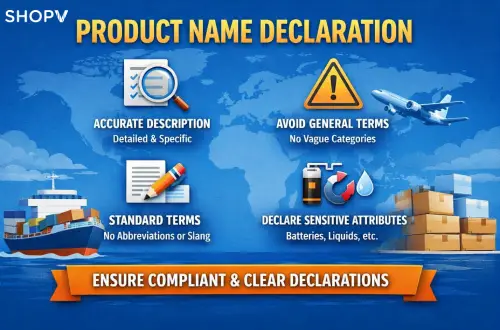
Shopv understands that for B2B sellers, an inspection doesn't just mean a delay—it means a break in the supply chain. Here is our professional breakdown of how to master Accurate Declaration to ensure your goods move through global borders without friction.
1. The Logic of Customs Inspection: Why Truthful Declaration Isn't Enough
Many B2B sellers believe that as long as they aren't "lying," they are safe. However, Customs Inspection is often triggered by "Informational Ambiguity" rather than "Intentional Deception."
Customs doesn't just check if you lied about the value. The first thing customs officers (and automated screening systems) look at is the product name. Then they cross-check value, material, intended use, and country of origin. If your Product Name Declaration is non-compliant — even by a small margin — the entire shipment gets flagged for focused inspection, regardless of how honest your declared value is.
The problem isn't dishonesty. It's non-standard naming, over-generalization, and inaccurate classification.
Customs systems use AI risk-scoring algorithms. When a product name is too broad, the system cannot verify the safety or trade compliance of the item, automatically flagging it for manual inspection. To bypass this, your Product Name Declaration must transition from "Category-based" to "Attribute-based."
2. Professional Standards for Filling in Product Names
To achieve an Accurate Declaration, follow these industry-standard guidelines used by top-tier fulfillment centers:
The "Material + Use + Name" Formula: Instead of writing "Bag," write "Polyurethane (PU) Leather Women’s Handbag." Instead of "Tube," write "Stainless Steel Industrial Exhaust Pipe."
Avoid Forbidden Generic Terms: Never use terms like "Samples," "Parts," "Accessories," "Equipment," or "Hardware." These are red flags. Specify what the part is for (e.g., "Aluminum Bicycle Brake Pads").
Standardized Terminology: Avoid internal SKU names or "Amazon-style" keyword-stuffed titles. Use universally recognized trade names. For example, use "Silicone Protective Case for Mobile Phone" rather than "Ultra-Slim Shockproof iPhone Cover."
Bifurcate Composite Goods: If you are shipping a "Smart Mirror," declare it based on its primary function or the HS code classification—usually "Glass Mirror with LED Lighting"—to ensure it matches the tariff schedule.
3. Advanced Risk Management for Large-Scale Shipments
For B2B sellers managing high-volume exports, consistency is the key to maintaining a low-risk profile with customs.
Documentary Unity: The product name must be identical across the Commercial Invoice (CI), Packing List (PL), and the Waybill. Even a minor discrepancy in wording (e.g., "Steel Nut" on the invoice vs. "Metal Fastener" on the waybill) can trigger an audit.
Sensitive Attribute Disclosure: If your products contain batteries (PI966/PI967), magnets, or liquids, these must be declared professionally. Hiding these attributes leads to "Security Interception," which is much harder to resolve than a standard customs check. A professional fulfillment partner like Shopv ensures these are labeled according to IATA and local customs standards.
The trick: Include the sensitive attribute as a factual descriptor, not as a warning label.
| Product | ❌ Hidden (Triggers Inspection) | ✅ Indicated (Passes Smoothly) |
|---|---|---|
| Lithium battery pack | "Electronic Device" | "Portable Power Bank with Lithium Battery (10000mAh)" |
| Magnetic phone mount | "Car Accessory" | "Magnetic Car Phone Mount (N52 Neodymium Magnet)" |
| Liquid skincare set | "Beauty Set" | "Glass Bottle Skincare Set (Toner + Serum, 100ml Each)" |
Customs respects transparency. When you state the attribute matter-of-factly, it signals compliance — not risk.
Value-to-Product Correlation: Ensure the declared value makes sense for the product name. A "Stainless Steel Watch" declared at $1.00 is an immediate red flag for Customs Inspection.
4. Why Professional Fulfillment is Your Best Defense
Navigating the complexities of global trade regulations is a full-time job. This is where Shopv’s large-scale shipment fulfillment service provides a competitive edge. We don't just ship boxes; we provide:
Pre-shipment Audit: We review your Product Name Declaration to ensure it meets the specific requirements of the destination country (e.g., FDA requirements for the US or CE standards for the EU).
HS Code Optimization: We help you find the most accurate classification to ensure compliance while potentially lowering duty costs.
Seamless Integration: Our system ensures that your data is consistent across all shipping documents, drastically reducing human error.
Shopv’s Large-Scale Fulfillment Advantage
At Shopv, we specialize in large-scale shipment fulfillment services designed to minimize customs risks. Our compliance team ensures every product name declaration is accurate, standardized, and aligned with customs requirements. By leveraging Shopv’s expertise, B2B clients reduce inspection rates, avoid costly delays, and maintain smooth global logistics operations.
Why B2B Sellers Choose Shopv?
For growing cross-border businesses, inaccurate declarations don’t just cause delays—they disrupt supply chains and customer satisfaction.
Shopv helps by:
Reducing inspection rates through optimized Product Name Declaration
Ensuring full compliance with international customs standards
Streamlining large-scale shipment fulfillment with automated workflows
Providing scalable solutions for high-volume sellers
The result is faster clearance, fewer disruptions, and predictable delivery timelines.
FAQ: What B2B Users Need to Know About Large-Scale Shipment Fulfillment
Q1: Will using a professional fulfillment service like Shopv actually reduce my inspection rate?
A: Yes. Customs authorities often assign "risk scores" to frequent shippers and logistics providers. By using Shopv, your goods benefit from our standardized declaration processes and our reputation for compliance, which can lead to faster "green channel" clearances.
Q2: What's the difference between Product Name Declaration and just writing a category name?
A: A category name ("electronics") is what triggers inspection. A Product Name Declaration ("USB-C Fast Charging Cable, Nylon Braided, 2m") is what gets you cleared. The more attributes you include (material, function, spec), the lower your risk.
Q3: Can I use the same product name for all my shipments to save time?
A: Absolutely not. Using a fixed template triggers system risk controls. Every SKU should have a unique, specific name. At Shopv, we auto-generate compliant names per SKU — no extra effort from you.
Q4: Is it better to declare a lower value to save on taxes for my B2B customers?
A: We strongly advise against "Under-declaration." Modern customs systems compare your declared value against a global database of similar commodities. Shopv helps you find the "compliance sweet spot"—declaring the lowest legal value based on transaction proof to minimize taxes without risking a Customs Inspection.
Q5: Why must invoices and packing lists match exactly?
Customs systems automatically compare shipping documents. Inconsistencies often trigger manual review or inspection.
Maximize your global reach and minimize shipping risks. Choose Shopv for professional, large-scale shipment fulfillment services and let the experts handle your international logistics compliance.








