





Peak Season Logistics: Proven Strategies to Protect Margins & Master Demand
The biggest peak-season logistics challenges are limited transportation capacity, higher shipping costs, warehouse congestion, customs delays, inventory imbalances, and increased returns. These problems become more difficult when a business waits until order volume has already increased to address them.
Table of Contents
- What is Peak Season Logistics?
- What Triggers Peak Season and Why Do Operations Fail?
- Peak logistics is not limited to Q4. Other peak periods may include
- What are the challenges associated with transportation during peak periods?
- How Early Should You Start Peak-Season Logistics Planning?
- How Can You Avoid Peak-Season Freight Capacity Shortages?
- How Do You Increase Warehouse Speed and Accuracy During Peak?
- Track the Right Fulfillment Metrics
- How Should You Manage Peak-Season Returns?
- FAQ: Peak Season Logistics and Fulfillment
To prepare for peak shipping season, businesses should forecast demand early, secure freight and warehouse capacity, position inventory closer to customers, validate customs documentation, stress-test fulfillment operations, and create contingency plans for carrier and inventory disruptions. The goal is not simply to ship more orders—it is to maintain delivery speed and order accuracy when transportation and warehouse capacity are under the most pressure.
For e-commerce brands, peak season can compress several major sales events into a few weeks. Black Friday, Cyber Monday, Christmas, Singles' Day, and other regional shopping events can create sudden increases in order volume while international transportation networks are already operating near capacity.
A successful peak shipping strategy therefore needs to begin before orders surge.
What is Peak Season Logistics?
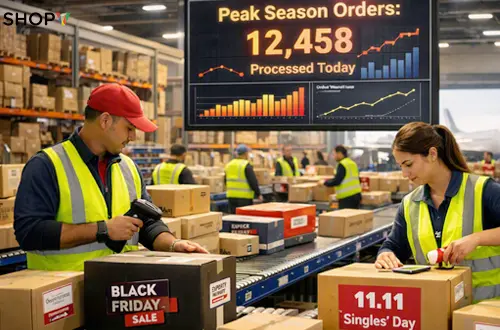
Peak season logistics refers to the strategic management, inventory placement, carrier allocation, and fulfillment operations required to handle predictable annual spikes in e-commerce and retail demand (typically Q4). Successful peak season logistics rely on three core pillars: demand forecasting accuracy, multi-carrier flexibility to avoid surcharges and volume caps, and decentralized inventory distribution to maintain fast delivery speeds while protecting operating margins.
What Triggers Peak Season and Why Do Operations Fail?
Peak season logistics operations typically experience volume surges between 3x and 7x above baseline daily averages. These spikes are driven by predictable shopping events, including Black Friday/Cyber Monday (BFCM), Q4 holiday shopping, back-to-school periods, and industry-specific seasonal trends.
Most fulfillment and supply chain networks fail during peak season not from a lack of warehouse space, but from critical operational bottlenecks:
- Single-Carrier Bottlenecks: Over-reliance on a single parcel carrier leads to strict volume caps, missed pickup windows, and steep peak surcharges.
- Inaccurate Safety Stock Placement: Storing inventory too far from final-mile destinations inflates shipping zone costs and lengthens delivery timelines.
- Labor Inefficiencies: Inability to rapidly scale order-picking throughput without exponential increases in labor costs or pick-error rates.
Peak logistics is not limited to Q4. Other peak periods may include:
- Amazon Prime events.
- Back-to-school shopping.
- Lunar New Year production cutoffs.
- Summer holiday sales.
- Product launches.
- Crowdfunding fulfillment waves.
- Category-specific seasonal demand, such as camping, fashion, toys, beauty, and gifting.
The objective is simple:
Peak-Season Success=Inventory Availability+Fulfillment Accuracy+Carrier Capacity+Delivery Reliability−Avoidable Cost and Delay
What are the challenges associated with transportation during peak periods?
1. Limited air freight capacity
Air cargo demand typically increases significantly around major shopping periods. When capacity becomes constrained, businesses may encounter:
- Higher freight rates
- Fewer available flights
- Longer booking lead times
- Rolled or delayed shipments
- More expensive last-minute transportation
This is particularly challenging for SMEs that do not have the purchasing volume of large retailers.
2. Customs congestion
Higher shipment volumes can increase the possibility of inspections, documentation issues, and clearance delays.
Products such as electronics, batteries, cosmetics, food, and other regulated goods require additional attention because classification or documentation errors can stop a shipment before it reaches the customer.
3. Warehouse congestion
Peak season problems do not start at the airport.
A warehouse can become a bottleneck when receiving, picking, packing, and dispatch volumes increase faster than available labor and processing capacity.
A useful peak-season KPI is not simply daily orders shipped, but orders shipped on time and without fulfillment errors.
4. Inventory imbalance
Demand forecasting errors can create two opposite problems:
- Understocking: lost sales and longer replenishment lead times
- Overstocking: additional storage costs and post-season inventory pressure
The challenge becomes greater when demand differs significantly between markets.
5. Returns and reverse logistics
More orders usually mean more returns.
For cross-border sellers, returning products internationally can be considerably more complicated than the original delivery because of transportation costs, customs procedures, product inspection, and restocking.
How Early Should You Start Peak-Season Logistics Planning?
Start peak-season planning at least 12–16 weeks before the inventory-available deadline for core products, and earlier for ocean freight, complex imports, seasonal production, or multi-country inventory positioning. The appropriate lead time depends on production, route, customs, warehouse, and marketplace requirements.
Peak-Season Planning Timeline
| Timing Before Peak | Primary Actions |
|---|---|
| 20–24 weeks | Review prior-year sales, returns, stockouts, carrier performance, and product profitability |
| 16–20 weeks | Build SKU-level forecast, confirm supplier capacity, identify hero products, and reserve packaging materials |
| 12–16 weeks | Place baseline purchase orders, select warehouse locations, and confirm import and customs readiness |
| 8–12 weeks | Book bulk sea, rail, or multimodal capacity; prepare labels, packaging, and receiving plans |
| 6–8 weeks | Ship high-confidence baseline inventory and reserve backup air and parcel capacity |
| 4–6 weeks | Position fast-moving safety stock, test order-routing rules, and confirm the warehouse labor plan |
| 2–4 weeks | Monitor sell-through daily, activate replenishment triggers, and ship only priority emergency stock by air |
| Peak weeks | Manage cutoffs, carrier performance, exceptions, inventory allocation, and customer communication |
| 2–8 weeks after peak | Process returns, recover sellable stock, analyze costs and performance, and plan improvements |
How Can You Avoid Peak-Season Freight Capacity Shortages?
The best way to avoid peak-season freight shortages is to forecast transportation requirements early, reserve capacity before demand reaches its highest point, and maintain alternative shipping options instead of relying on a single carrier or route.
For international e-commerce, transportation planning should include more than a single shipping method.
| Freight Mode | Role in Peak Strategy | Recommended Use |
|---|---|---|
| Sea freight | Lowest-cost baseline inventory movement | Planned, high-volume inventory with long lead time |
| Rail/multimodal | Mid-speed, mid-cost alternative on suitable lanes | Europe-bound inventory that needs more speed than ocean freight |
| Commercial air freight | Urgent bulk replenishment | High-margin, high-velocity SKUs with proven demand |
| Dedicated air line | Ecommerce restock and small-to-medium volume | Time-sensitive stock needing a lower entry threshold than commercial air freight |
| International express | Emergency samples, small replacement stock, and urgent parts | Small, high-value, time-critical shipments |
| Regional warehouse transfer | Fast replenishment within market | Move safety stock to FBA, retail, B2B, or local fulfillment nodes |
The objective is not to use the cheapest transportation option at all times.
The objective is to maintain acceptable cost + delivery speed + capacity reliability when the preferred route becomes constrained.
Avoid last-minute transportation decisions
A common peak-season mistake is waiting for actual orders before booking transportation.
By then, capacity may already be limited and the remaining options may carry substantially higher costs.
How Do You Increase Warehouse Speed and Accuracy During Peak?
Increase peak-season warehouse performance by simplifying workflows before volume rises, not by relying only on extra labor after the rush begins. The best peak warehouse processes reduce touches, remove unclear instructions, and isolate exceptions early.
Pre-Peak Warehouse Preparation
- Complete inbound receiving before promotion dates.
- Confirm barcode, SKU, bundle, and carton-label data.
- Create written packing instructions for each SKU.
- Pre-build fast-selling kits and bundles.
- Pre-position popular SKUs in easy-access pick locations.
- Reserve enough cartons, inserts, labels, tape, and dunnage.
- Establish cutoffs for same-day dispatch.
- Confirm carrier pickup schedules and backup pickup options.
- Train temporary workers on scanning and exception procedures.
- Establish a designated problem-solving area for damaged, missing, or mismatched items.
- Conduct cycle counts on high-velocity SKUs before launch.
Track the Right Fulfillment Metrics
| Metric | Why It Matters |
|---|---|
| Order cut-off compliance | Shows whether orders are dispatched when promised |
| Same-day ship rate | Measures peak fulfillment speed |
| Pick accuracy | Reduces wrong-item shipments and refunds |
| Inventory accuracy | Prevents overselling and cancellations |
| Order exception rate | Identifies products or processes causing delays |
| Carrier pickup success | Ensures packed orders actually leave the warehouse |
| On-time dispatch rate | Supports marketplace and customer delivery commitments |
| Damage rate | Reveals packaging or handling problems |
| Return-to-stock cycle time | Determines how quickly sellable returns become available |
| Backlog age | Shows whether warehouse capacity is falling behind |
3PL perspective: A warehouse is not truly “caught up” because every order is picked. It is caught up when shipped orders have carrier acceptance scans, inventory is accurate, exceptions are controlled, and returns are not blocking outbound operations.
How Should You Manage Peak-Season Returns?
Manage peak-season returns by designing the reverse-logistics workflow before sales begin, including return authorization, local return addresses, inspection rules, refund timing, restock decisions, and disposal/refurbishment paths.
FAQ: Peak Season Logistics and Fulfillment
What is the most important peak-season logistics KPI?
Inventory available to fulfill orders is the key outcome metric. Supporting KPIs include days of stock cover, on-time dispatch, pick accuracy, inventory accuracy, carrier pickup success, inbound ETA accuracy, and returns-processing time.
Should I ship all peak inventory by air freight?
Usually no. Air freight is expensive and capacity can tighten during peak. A better model often sends predictable baseline stock by sea, rail, or multimodal freight and reserves air freight for high-velocity, high-margin, or urgent replenishment.
How much safety stock should I hold for peak season?
The right level depends on demand volatility, replenishment lead time, service-level target, margin, storage cost, and stockout risk. Calculate safety stock at SKU level rather than applying one percentage to all products.
How can I avoid peak-season customs delays?
Complete customs and product-compliance checks before the cargo is collected. Confirm HS codes, product descriptions, values, origin, importer data, VAT/EORI/IOSS requirements where applicable, product records, and broker authorization. Use a “no cargo, no data” rule.
Why is overseas warehousing important during peak season?
An overseas warehouse positions inventory closer to customers. This can improve delivery speed, reduce repeated cross-border parcel cost, provide flexible carrier choices, support local returns, and enable faster replenishment to DTC, B2B, or marketplace channels.








